
Key Facts
- The Good Guys ran Store Credit and StoreCash promotions for four years until August 2023.
- The promotions were very successful. About 278,000 credit vouchers were issued.
- Some store credits were used and generated sales. But about 65.8% of the credits were not redeemed, which meant that the Good Guys received a financial benefit of an estimated $14,400,000 in unredeemed credit.
- Why were so many credit vouchers not redeemed?
- Was there a link between the high number of unredeemed credit vouchers and the high number of complaints The Good Guys’ customer solutions team received from customers that their credit redemption period had expired? Or was it because customers had not even received Store Credits to which they were entitled?
- Did this mean that The Good Guys had engaged in unfair consumer practices?
- The regulators – Australian Competition & Consumer Commission (ACCC) and Australian Securities & Investments Commission (ASIC) considered The Good Guys had engaged in unfair practices and prosecuted The Good Guys for misleading conduct under the Australian Consumer Law.
- The Good Guys admitted the misleading conduct and agreed to penalty and remediation orders.
- The Court ordered penalties totalling $13.5 million and made remediation orders.
The Federal Court of Australia decision is Australian Competition and Consumer Commission v The Good Guys Discount Warehouses (Australia) Pty Ltd [2025] FCA 1085 (the Honourable Justice O’Bryan) (8 September 2025).
This is an analysis. A marketer’s insight follows.
The Business and the Advertisements
The Good Guys is an Australian consumer electronics and household appliance retailer. The Good Guys supplies products which range in price from less than $20 to more than $1,000. Its business is conducted from 107 physical stores across Australia, online at www.thegoodguys.com.au (The Good Guys’ website) and by a telephone sales line.
Since late 2016, The Good Guys has been a wholly owned subsidiary of JB Hi-Fi Limited, which is listed on the Australian Securities Exchange.
The Good Guys’ sales revenue for the fiscal year 2024 was $2,679.1 million, and its gross profit for 2024 was $621.2 million.
These examples of misleading advertisements with store credit promotions are taken from ACCC Media release - The Good Guys to pay $13.5m penalty for misleading store credit promotions –
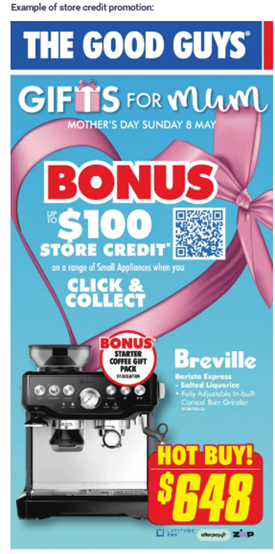 |
 Note: the Store Credit promotion was used from 25 July 2019 to 14 August 2022, and the StoreCash promotion was used from 5 September 2022 to 31 August 2023. |
Each advertisement contained one or more of the following:
- words to the effect of “Bonus”, “Online Offer”, or “Online Bonus Buy” displayed, typically at the top of the advertisement in large font;
- words to the effect of “Earn StoreCash”, “Get … StoreCash”, “Start earning StoreCash”, “Double your StoreCash”, “Earn to Pay Less” or “Earn StoreCash to Pay Less” displayed, typically at the top of the advertisement in large font; and/or
- the numerical value of the Store Credit or the StoreCash offered in the relevant promotion displayed.
The key preconditions to credit redemption such as the credit expiry period and that the customer must opt-in to receiving marketing communications to receive the credit were not displayed on the face of the advertisement. They were hidden in the terms and conditions which were accessed in one of these ways:
- A URL or hyperlink directly to the terms and conditions or to a specific promotion webpage or the Store Credit or StoreCash webpage or The Good Guys’ home webpage.
- A QR Code (such as in the advertisement on the left above) directing to a webpage.
- A symbol (for example “<”) directing customer’s attention to an explanatory note, either in the body of the advertisement or in a footer, containing words to the effect “T&Cs apply” or “See online for details”.
The absence of up-front or inadequate disclosure of the key conditions was the misleading conduct.
The advertisements featuring the promotions were displayed in various media:
- On The Good Guys’ website
- In email advertisements and SMS messages sent to consumers who had subscribed / opted-in to receive marketing material from The Good Guys*
- On social media
- In electronic catalogues (available on The Good Guys’ website or on third party websites)
- On third party websites
- In print media such as newspaper advertisements, catalogues, physical posters and banners displayed in-store
- (for one promotion) in a national television commercial
*The Good Guys sent over 5.3 million text messages and over 6.4 million emails to consumers advertising the Store Credit promotions, as well as a large number of emails and text messages advertising the ‘by invitation’ StoreCash promotions.
Store Credit and StoreCash promotions
Store Credit promotions ran for one week on average and StoreCash promotions ran for three weeks on average.
The promotions were very successful:
- Approximately 105,000 individual Store Credit vouchers were provided to customers as part of a Store Credit promotions. The dollar value was between $10 and $120 for each. Approximately $1,600,000 was redeemed and $4,100,000 was not.
- Approximately 173,000 individual StoreCash vouchers were provided to customers as part of a StoreCash promotions. The dollar value was between $10 and $1,000 for each. Approximately $5,900,000 was redeemed and $10,300,000 was not.
The credits provided were able to be redeemed in these ways:
- Store Credit was provided by way of an email or SMS message. The consumer could redeem the Store Credit with The Good Guys via The Good Guys’ website, by telephone or at The Good Guys’ physical stores, subject to the credit-expiry condition.
- StoreCash was provided through a digital wallet on a smart device, such as a smart phone. The consumer could redeem the StoreCash via The Good Guys’ website, by telephone or at The Good Guys’ physical stores, subject to the credit-expiry condition.
Contraventions of the Consumer Law
The Court examined three categories of contravening conduct:
- Opt-in conduct (agreeing to receive marketing material as a pre-condition to the credits);
- Credit-expiry conduct (not clearly displaying the credit-expiry period on the advertisements); and
- Credit provision conduct (customers not receiving Store Credits to which they were entitled).
The Court made these observations:
“There are features of the three categories of contravening conduct that are similar.
In particular, all of the three categories of contravening conduct concerned promotions by which The Good Guys offered to provide to consumers a credit upon making a qualifying purchase from The Good Guys.
Further, the effect of all of the categories of contravening conduct was to prevent an eligible consumer receiving the credit or, in a practical sense, from being able to redeem the credit.
However, there are also features of each of the categories of contravening conduct that differ …
[As to the opt-in conduct] The Good Guys’ failure was to … not alert consumers to the necessity to remain opted-in to receiving marketing communications [to receive the Store Credit].
[As to the credit-expiry conduct, even though] The Good Guys’ customer solutions team received a significant number of complaints …. relating to the Store Credit and StoreCash expiry periods [that customers were not aware of them, yet] … The Good Guys did not cease engaging in the credit-expiry conduct until after it was put on notice of the ACCC’s concerns about that conduct on 16 August 2023.
[As to the credit provision conduct] The Good Guys failed to provide the Store Credit within the time specified … [in the majority of cases] … because of technical issues with The Good Guys’ IT systems…. The failure to provide Store Credit was not adequately identified by The Good Guys’ compliance systems and processes until July 2022” [judgment paras 88-93]
The numbers of customers affected was significant: approximately 21,500 customers were not provided the store credit within the specified time out of 109,000 individual consumers who qualified to receive a store credit as part of a Store Credit / StoreCash promotion.
In assessing the penalty, the Court found that although The Good Guys had a detailed Australian Consumer Law compliance program in place, the internal review processes for advertisements and complaints escalation processes were deficient:
“Despite the receipt of a significant number of complaints in 2022 and 2023 regarding the expiry periods for Store Credit and StoreCash and from consumers who reported they had not received Store Credits despite not opting out of receiving marketing communications, the issues were not promptly escalated to senior management for resolution and remediation, as they should have been. This demonstrates a failure in The Good Guys’ complaints management and escalation processes.” [judgment para 107]
Both the Australian Consumer Law (ACL) and the Australian Securities and Investments Commission Act 2001 (Cth) (ASIC Act) contain analogous provisions of consumer law.
S 12DA(1) and s 12DF(1)) of the ASIC Act apply to the opt-in conduct and the credit-expiry conduct because they relate to the supply of Store Credit and StoreCash as financial services.
s 12DA(1) is:
-
- A person must not, in trade or commerce, engage in conduct in relation to financial services that is misleading or deceptive or is likely to mislead or deceive.
s 12DF(1) is:
-
- A person must not, in trade or commerce, engage in conduct that is liable to mislead the public as to the nature, the characteristics, the suitability for their purpose or the quantity of any financial services.
S 32(2) of the ACL applies to the credit provision conduct because it relates to the offer of Store Credit in connection with the supply or possible supply of goods or the promotion by any means of the supply or use of goods.
s 32(2) is:
If a person offers any rebate, gift, prize or other free item in connection with:
(a) the supply or possible supply of goods or services; or
(b) the promotion by any means of the supply or use of goods or services; …
the person must, within the time specified in the offer or (if no such time is specified) within a reasonable time after making the offer, provide the rebate, gift, prize or other free item in accordance with the offer.
The Court Orders
The Court made these orders:
- A penalty of $1,500,00 in respect of the opt-in conduct
- A penalty of $10,000,000 in respect of the credit-expiry conduct
- A penalty of $2,000,000 in respect of the credit provision conduct
- The implementation of a consumer redress regime for consumers who did not redeem Store Credit or StoreCash
- The Good Guys to pay the ACCC and ASIC’s legal costs of $200,000.
The ACCC’s comments
The ACCC was pleased with the result. This is from the ACCC Media release (9 September 2025)
“We took this court action because we were concerned that The Good Guys had failed to adequately disclose some really key conditions attached to these store credit promotions,” ACCC Chair Gina Cass-Gottlieb said.
“The chance to earn store credit may have encouraged some consumers to make a purchase at The Good Guys they otherwise may not have made or to choose this retailer over others. We were concerned some of those consumers may not have done so had they been aware of all the conditions.”
“When advertising promotional offers, all businesses must clearly disclose any key terms and conditions or limitations to avoid misleading consumers. Businesses that fail to do so could potentially face court proceedings and large penalties,” Ms Cass-Gottlieb said.