
The ACCC is prosecuting Grill’d because only 4 out of every 100 burgers it sold qualified for the donation of $1 per burger promised for tree planting. The other 96 burgers sold in the Tree Day Tuesday promotion did not qualify – they were excluded by the conditions.
The ACCC (Australian Competition & Consumer Commission) has commenced proceedings in the Federal Court of Australia against Grill’d seeking declarations, penalties, costs and other orders. See ACCC Media – Grill’d in court for allegedly misleading customers about ‘Tree Day Tuesday’ donations.
This article examines why the ACCC labels Grill’d’s conduct as greenwashing and misleading contrary to the Australian Consumer Law.
The Grill’d Tree Day Tuesday promotions
Grill’d used social media posts on Facebook, Instagram, Linkedin and a Website, as well as in-store promotional posters for the Tree Day Tuesday promotion. These are examples:
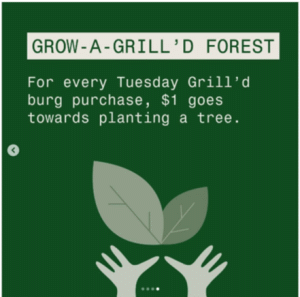 Screenshot of a post on the Grill'd Facebook page and Instagram page |
 |
- You can help us grow our 100-year protected forest by buying a burger today. A burger for you, a baby tree for the planet.
- If you don’t have time in that busy schedule of yours to plant a tree today, swing by for a burger instead and we’ll plant one for you. Every burger purchased by our Relish members today helps grow our Grill’d Forests. That’s something for you and for the planet.
- … we’re donating $1 from every burger ordered by Relish Members on Tuesdays to team with the Traditional Guardians of the land and plant trees that will be protected to grow from root to branch to leaf for a century.
Twenty-six Tree Day Tuesday promotional advertisements contained alleged misleading statements – which the Australian Consumer Law calls ‘representations’.
Why does the ACCC allege the Tree Day Tuesday promotions were misleading?
Grill’d is large fast-food chain with around 173 stores operating around Australia. Grilled markets itself as a business with a focus on sustainability, the environment and contribution to the community.
The facts
Over five million burgers were purchased on a Tuesday during the period between January 2021 and April 2024 during the Tree Day Tuesday promotion.
But of the burgers sold, Grill’d made a donation of $1 per burger for only 4 per cent of the burgers purchased overall. The proportion was higher for burgers bought by Relish members, but only 17 per cent of their purchases qualified for the $1 donation.
The rest of the purchases were excluded from qualifying for the $1 per burger donations by the restrictive conditions that applied, which were:
- the purchase had to be made on a Tuesday
- the purchase had to be of a ‘main item’ (being a burger or a salad)
- the buyer had to be a member of Grill’d’s Relish loyalty program
- the purchase had to be dine-in only and not takeaway, online order or delivery
- the offer was valid only for dine-in orders placed at the front counter (orders made via QR code at a table did not qualify)
- the buyer had to scan their loyalty program bar code at the counter when ordering
- the purchase could not be made in conjunction with any other offer
All of the conditions needed to be met for the donation to be made.
The breaches of the Australian Consumer Law
Grill’d must comply with the Australian Consumer Law. The ACCC highlighted these contraventions in the Tree Day Tuesday promotions:
Section 18 – Grill’d had engaged in conduct that was misleading or deceptive or was likely to mislead or deceive;
Section 29(1) – Grill’d had made false or misleading representations in connection with the supply, possible supply or promotion of burgers:
29(1)(g)
as to the environmental benefits and/or financial benefits to an environmental cause consequent upon purchasing its burgers; or resulting from purchasing its burgers; or
29(1)(m)
the existence of conditions applicable to the promotion.
The ACCC’s case has two aspects:
- Overstating the environmental contributions (greenwashing)
“We allege Grill’d misled customers by overstating the extent of the donations it would make and the environmental contributions from its Tree Day Tuesday promotion. We consider this to be a form of greenwashing,” ACCC Chair Gina Cass-Gottlieb said. - Depriving consumers of an informed decision (deception)
“We allege that Grill’d deprived consumers of the ability to make an informed decision by overstating the circumstances in which it would make a donation to an environmental cause, which may also have given Grill’d an unfair competitive advantage.”
“Any business that seeks to appeal to consumer’s environmental concerns must make sure that it’s claims are accurate and that any conditions or qualifications are adequately disclosed,” Ms Cass-Gottlieb said.
Comment
Environmental claims and greenwashing are a 2026-27 Annual Priority for the ACCC
 |
The ACCC has several current proceedings for greenwashing, including:
- Federal Court proceedings against Edgewell Personal Care Australia Pty Ltd and its US-based parent company, Edgewell Personal Care Company or Edgewell PCC, for allegedly false or misleading claims that its popular Hawaiian Tropic and Banana Boat branded sunscreens were ‘reef friendly’.
- Federal Court action against gas distributor Australian Gas Networks Limited alleging it made false and misleading representations in its ‘Love Gas’TV and digital advertising campaign.
The ACCC was successful in April 2025 when the Federal Court ordered Clorox Australia Pty Ltd (Clorox) to pay a total penalty of $8.25 million for making false or misleading representations to consumers that certain GLAD kitchen and garbage bags were partly made of recycled ‘ocean plastic’, following court action by the ACCC.
The proceedings against Grill’d break new ground for the ACCC on greenwashing because they centre around donations to an environmental cause, which fell far short of what they appeared to be because of the restrictive conditions that applied.